Consumer Walkie-Talkies vs. Commercial Two-Way Radios: When is it Time to Upgrade?
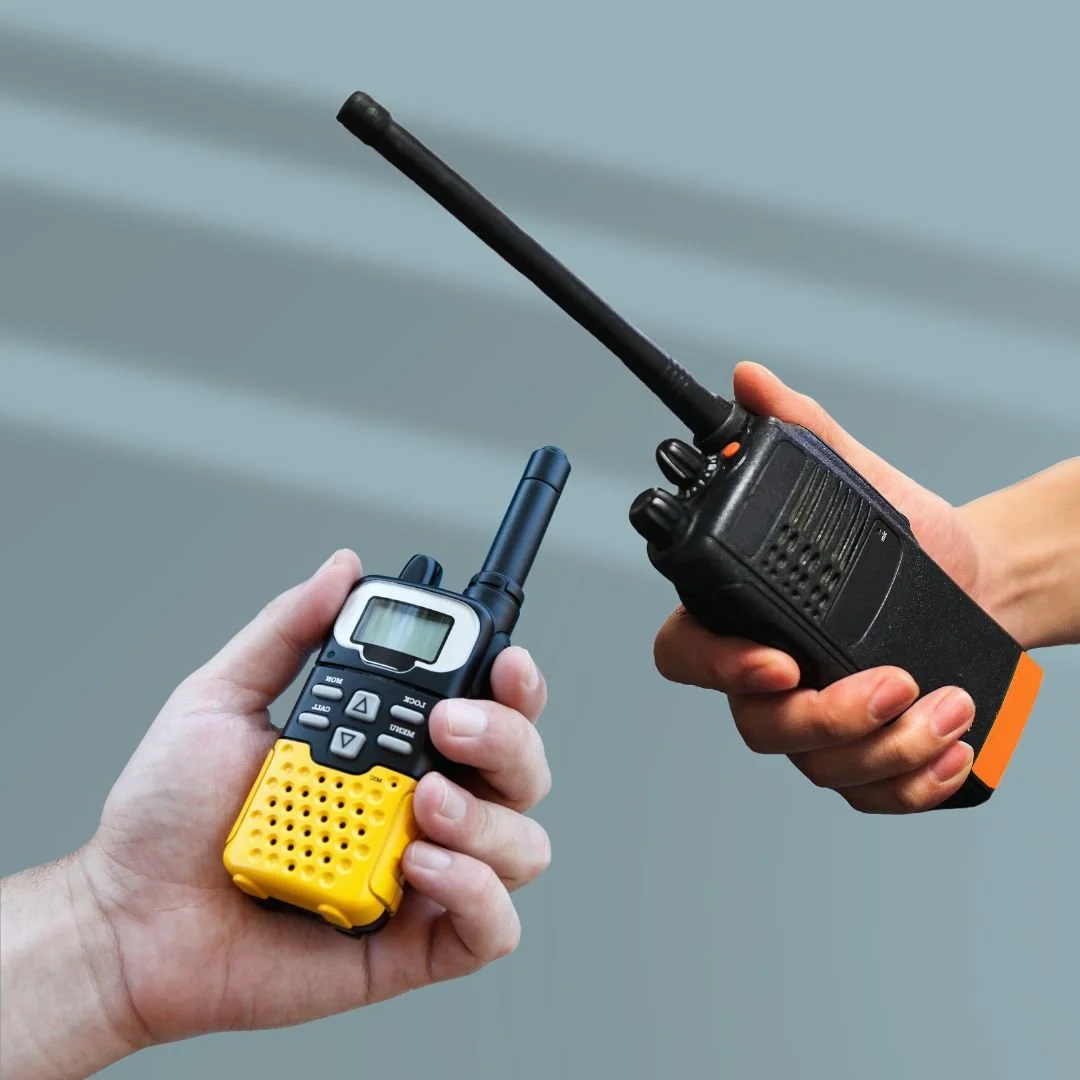
It is a common story across almost every industry: a business needs to get their staff connected quickly, so they head to a big-box retailer and buy a pack of cheap consumer walkie-talkies.
For a few weeks, they seem to do the job. But soon, the batteries start dying halfway through a shift, the audio becomes a wall of static, and the plastic clips snap off.
While they may look similar at a glance, consumer walkie-talkies and professional two-way radios are engineered for fundamentally different applications. Selecting the incorrect device can result in communication failures and operational inefficiencies.
If your team is currently relying on cheap handsets, here is how to understand the exact technical differences between consumer and commercial radios—and how to know when it is time to upgrade.
Four Signs Your Business Has Outgrown Walkie-Talkies.
It is time to transition to a professional radio fleet if your team is experiencing any of the following operational roadblocks:
1. You are experiencing constant radio interference. Walkie-talkies operating on shared, public frequencies means anyone with a similar device can listen in or interrupt conversations. If you need private communications, professional radios utilize licensed VHF and UHF bands. This permits protection from interference and ensures your channels remain secure for your staff only.
2. Your communications are blocked by dead zones. Walkie-talkies are restricted to low power output, typically between 0.5 and 2 watts. Professional radios operate at higher power levels, with portable units reaching up to 5 watts. This permits significantly greater range. If your radios are being used through concrete and steel structures, the superior performance of a professional two-way radio is necessary.
3. Your devices keep breaking on site. Consumer walkie-talkies are intended for recreational and light duty use. Engineered for reliability in harsh conditions, professional radios are often certified to military standards for durability against shock, vibration, and extreme temperatures. They also carry Ingress Protection (IP) ratings, which specify their resistance to dust and water.
4. The long-term replacement costs are adding up. Walkie-talkies have a very low upfront cost, making them attractive for casual users. However, their lack of durability leads to frequent replacement, and they cannot be serviced, resulting in a higher long-term cost for any organization that relies on them. Professional radios justify their initial investment through repairability and multi-year warranties, leading to a lower total cost of ownership over the life of the system.
The Quick Comparison: Consumer vs. Commercial Radios
When deciding between a consumer device and a professional tool, it hinges on a clear understanding of your operational requirements. Here is how they stack up technically.
Intended Use
Consumer Walkie-Talkies: Recreational, light-duty use.
Commercial Two-Way Radios: Daily business operations, industrial settings, and public safety.
Power Output
Consumer Walkie-Talkies: Typically 2 watts or less.
Commercial Two-Way Radios: Up to 5 watts for portable handheld units.
Licensing & Frequencies
Consumer Walkie-Talkies: Licence-free operating on fixed public channels.
Commercial Two-Way Radios: Licensed or enterprise-managed spectrum for private channels.
Audio Performance
Consumer Walkie-Talkies: Basic audio clarity with limited background noise rejection.
Commercial Two-Way Radios: Superior audio performance with industrial noise cancellation.
Scalability
Consumer Walkie-Talkies: Fixed capabilities with no path for fleet growth.
Commercial Two-Way Radios: Highly scalable; allows adding users, expanding coverage, and integrating features as you grow.
The Right Commercial Upgrade for Your Site
If your business has outgrown consumer walkie-talkies, transitioning to commercial hardware is a straightforward process once you know what your environment demands.
For industrial and heavy-duty sites, the Motorola MOTOTRBO R2 serves as a reliable everyday workhorse with excellent noise cancellation. For extreme environments, such as large-scale events or remote film sets, the Motorola R7 is the industry standard for maximum durability and audio clarity.
However, heavy-duty radios are not always the right fit. If you operate a hotel, restaurant, or premium retail store, clipping a bulky industrial radio to a uniform can detract from the guest experience. For hospitality and customer-facing teams, devices like the Motorola Curve—which combines traditional push-to-talk with Wi-Fi-enhanced voice assistance—or the ultra-discreet, wearable Motorola TLK 25 are much better suited. They offer professional-grade, secure connectivity in a lightweight, sleek profile.
If you are unsure which commercial system makes the most sense for your operational footprint, the team at Roar Radios is available to help you evaluate your site and find a practical, permanent solution.