
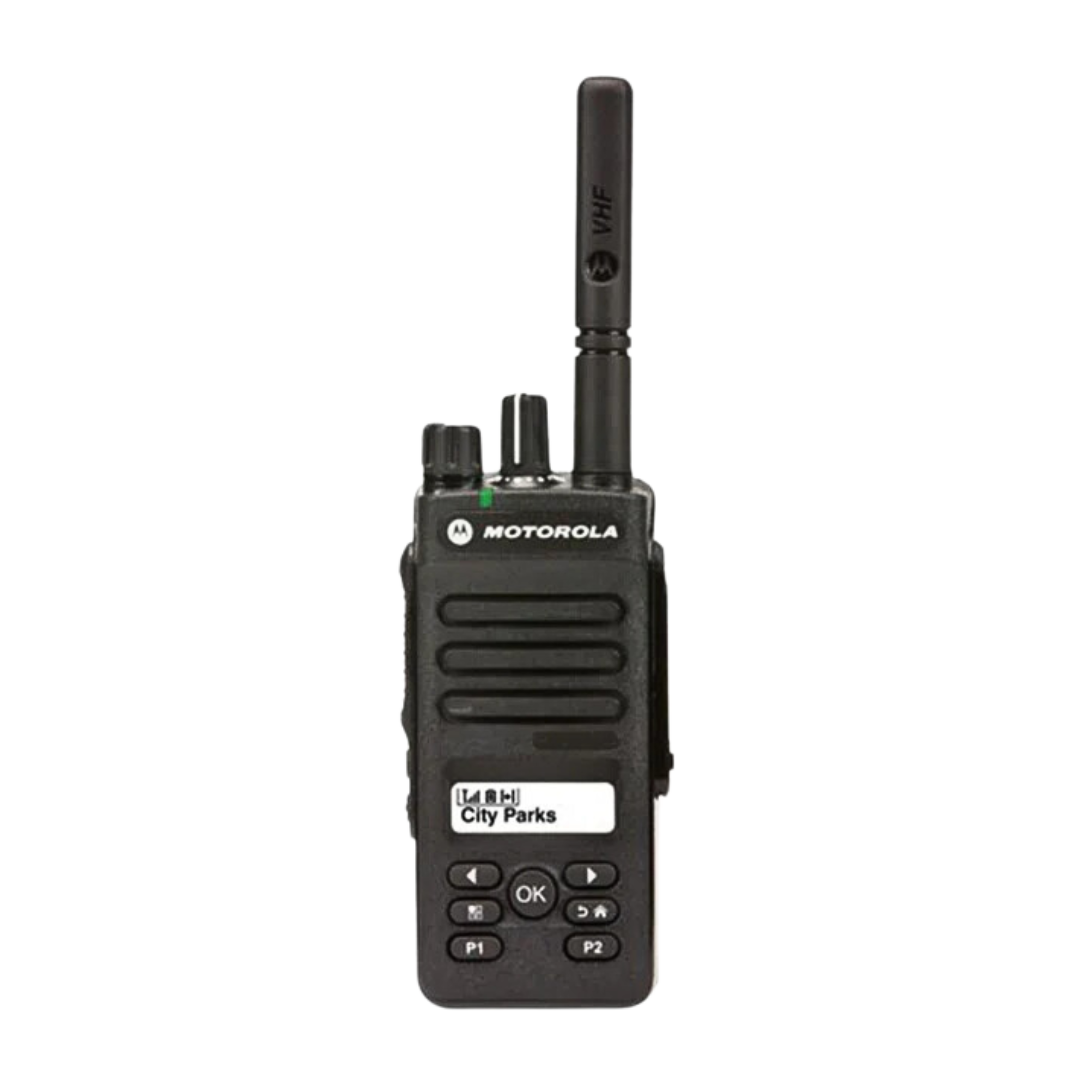
The Industry Standard: Motorola DP2600e Digital Radio
If you’ve worked on a film set or a festival site in Australia, you’ve probably held this radio.
The Motorola DP2600e is the industry standard for a reason. It bridges the gap between the old-school bricks and modern tech.
While it is a fully capable digital unit, we often program these in Analogue mode because that’s what film crews prefer. You get that instant, zero-delay response you’re used to, with the build quality of a modern Motorola.
The killer feature? The OLED display screen. Even in analogue mode, you don't want to be counting clicks on a knob to guess if you’re on the right channel. You look at the screen, see "Channel 1: PROD," and you start talking.
Film & TV Standard ✶ OLED Channel Display ✶ Clear Audio ✶ Construction Sites ✶ Compact & Light ✶ Event Management ✶ IP67 Waterproof ✶
Film & TV Standard ✶ OLED Channel Display ✶ Clear Audio ✶ Construction Sites ✶ Compact & Light ✶ Event Management ✶ IP67 Waterproof ✶
Who Is This For?
-
We know film crews prefer the instant response of analogue audio. We program these units in Analogue Mode so you get that natural, zero-delay sound you expect, but with the benefit of the OLED screen. You don’t have to guess if you are on "Channel 1" or "Channel 5"—the screen clearly says "UNIT" or "ELECTRICS." It’s the best of both worlds.
-
When you hand a radio to a volunteer, it needs to be idiot-proof. The DP2600e is simple. The display screen tells them exactly what channel they are on (e.g., "Medical" or "Parking"), reducing the "I can't find the right channel!" panic calls. Plus, the battery lasts a full 12-hour shift.
-
This radio bridges the gap between a basic brick and a high-end safety radio. It is rated IP67 (waterproof and dust-tight), so it survives a muddy job site easily. The screen allows supervisors to see exactly which talk group they are on (e.g., "Crane 1" vs "Ground Crew") without needing a cheat sheet.
-
Perfect for Fire Wardens or Warehouse Supervisors who need to coordinate multiple teams. The ability to see battery life and signal strength on the screen takes the guesswork out of safety drills. It’s simple enough that staff don't need a training session to use it.